
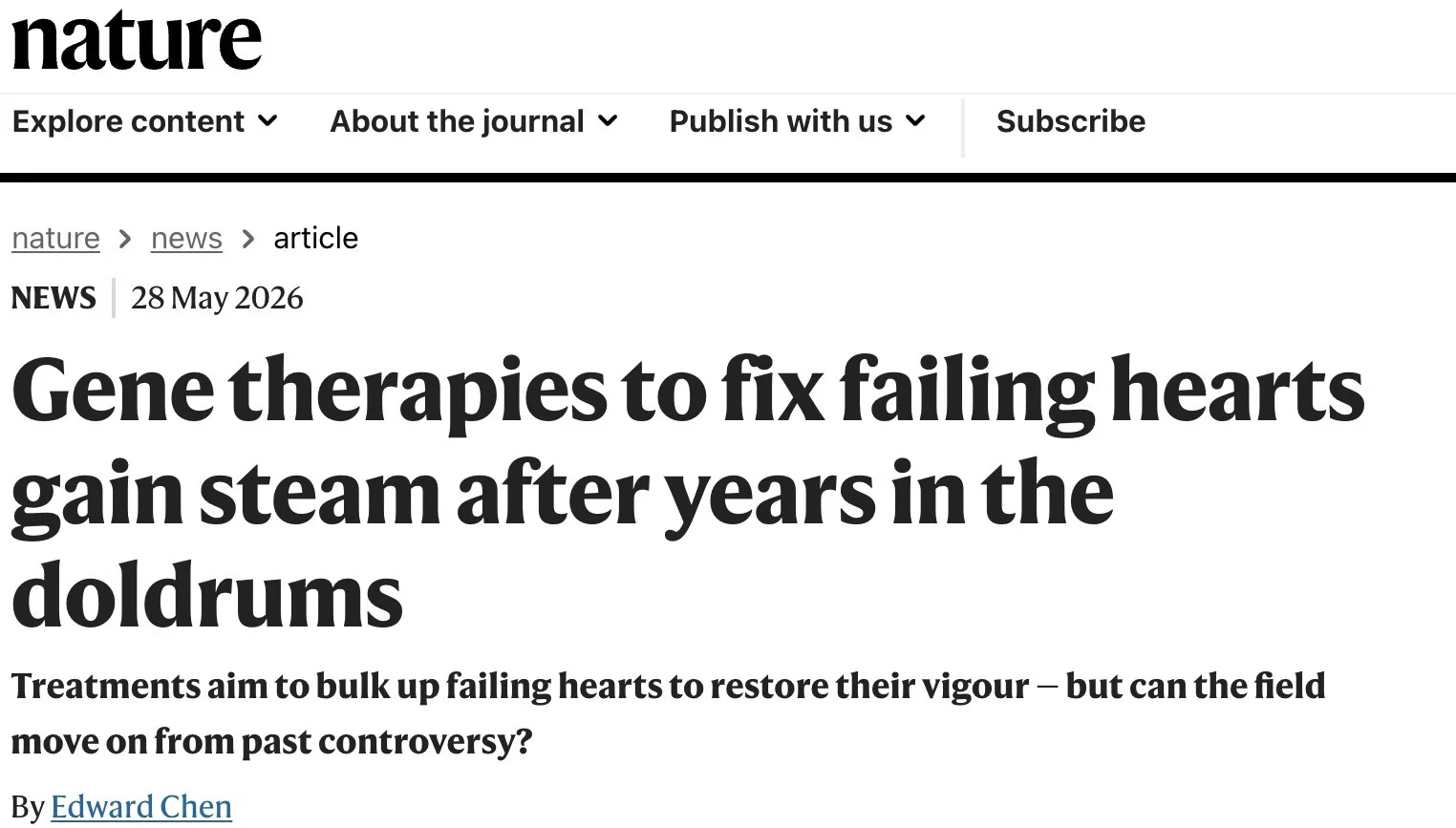
A new feature article in Nature highlights the growing momentum behind cardiac gene therapy, and our work is at the center of the story. Published last week by science journalist Edward Chen, the piece surveys the current landscape of gene therapies aimed at treating heart failure, a condition affecting tens of millions of people worldwide and expected to grow significantly in the coming years. The article, titled "Gene therapies to fix failing hearts gain steam after years in the doldrums," focuses on a new class of regenerative approaches that go beyond managing symptoms, therapies designed to get the heart to actually heal itself by prompting heart muscle cells to divide and regenerate lost tissue.
The Science Behind the Approach

Cover Issue for our 2021 gene therapy studies in mice and pigs.
The mammalian heart has essentially no capacity to repair itself after injury. When cardiomyocytes, the muscle cells responsible for the heart's pumping action, are damaged or lost, they aren't replaced. This is the underlying problem in heart failure, and it's why existing drugs can only do so much.
Our approach targets this fundamental limitation directly. We developed a gene therapy that delivers small RNA molecules into cardiomyocytes via an AAV vector. Once inside the cell, these RNA snippets silence SAV1, a gene that encodes a protein in the Hippo signaling pathway, a key molecular brake on cell proliferation. By dialing down SAV1 expression, the therapy releases the brake, allowing cardiomyocytes to re-enter the cell cycle and divide.
In preclinical studies in mice and pigs, treated animals showed evidence of cardiomyocyte division. In a pig model of heart attack, the therapy improved ejection fraction, the standard measure of how much blood the heart pumps per beat, by 14%. That data, published in Science Translational Medicine, helped convince U.S. regulators to approve a first-in-human clinical trial, which began in June 2026.
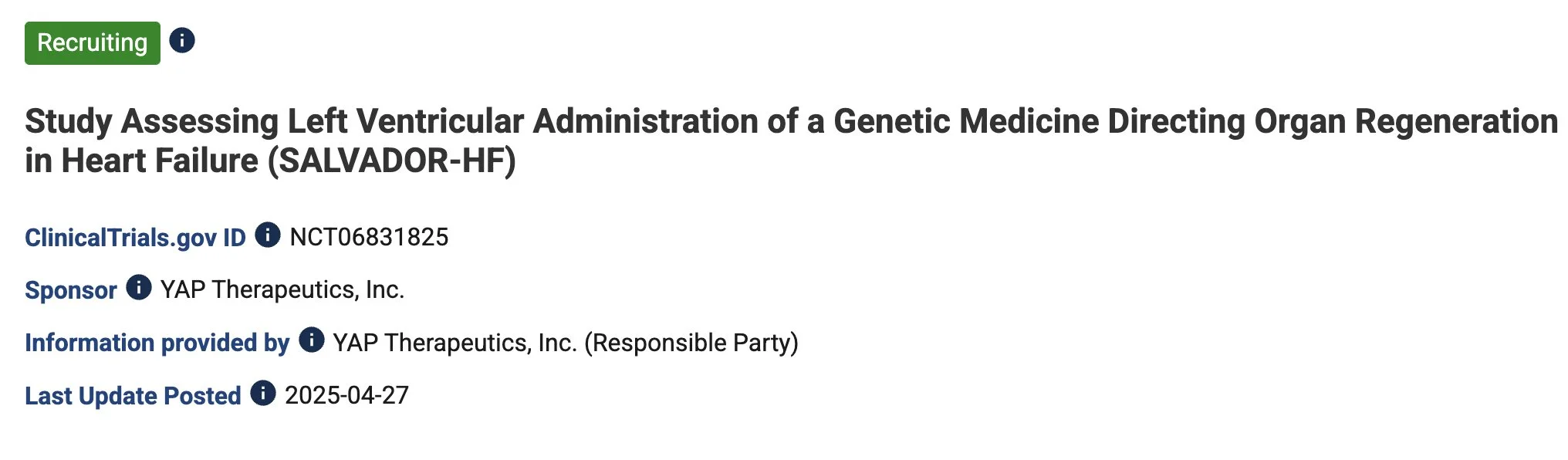
Our clinical trial: https://clinicaltrials.gov/study/NCT06831825?limit=100&intr=YAP101%20%5C(AAV9-Sav-shRNA%5C)&rank=1
A Historic Milestone
The Nature article frames this trial as a landmark moment: the first clinical study specifically designed to test cardiac regeneration in humans. As Andrew Baker of the University of Edinburgh put it in the piece, "These are the first-in-human studies to take regeneration into the clinic. It's a very exciting time."
The article also acknowledges the scientific debate that comes with any first-in-human effort. Some researchers want additional evidence distinguishing true cell division from other processes that can produce similar readouts, such as binucleation. We addressed this directly, noting that the technology has matured to the point where clinical trials, with human outcome data, are now the appropriate next step. "Some people you will never convince," Dr. Martin said. "The only way to provide answers is to go to trial."
Thirty Years in the Making
This moment reflects decades of foundational work in cardiovascular biology. We have spent years dissecting the Hippo-YAP pathway and its role in controlling heart size, cardiomyocyte proliferation, and cardiac repair. The transition from basic science discovery to a regulatory-approved clinical trial is exactly the kind of translational arc that has motivated this research program from the start. We're proud to see this work recognized in one of the world's leading scientific journals, and we look forward to sharing results as the clinical program advances.
Read the full article in Nature: Gene therapies to fix failing hearts gain steam after years in the doldrums
Key reference: Liu S. et al. Sci. Transl. Med. 13, eabd6892 (2021). https://doi.org/10.1126/scitranslmed.abd6892